
ACLS or PALS? Choosing Advanced Certification for Snellville Clinicians
Local Guides
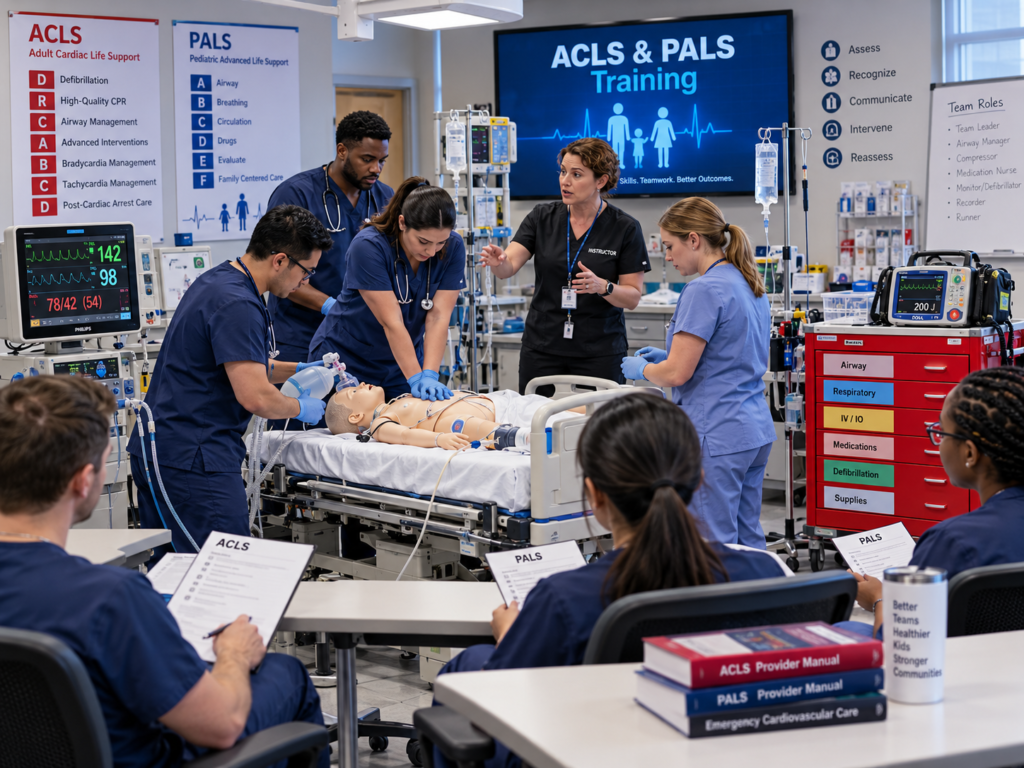
If you work at Piedmont Eastside Medical Center or one of the practices around Snellville, BLS is almost certainly your baseline card. But many roles ask for more — ACLS, PALS, or both — and it is not always obvious which applies to you. This guide explains the difference and how to work out what your role needs.
The short version
- BLS — the baseline for almost every clinical role: high-quality CPR, AED use, ventilation and team response.
- ACLS — advanced care for adults in cardiac arrest and other cardiovascular emergencies.
- PALS — advanced care for seriously ill or injured infants and children.
ACLS and PALS both build on BLS. Neither replaces it, and many employers expect a current BLS card alongside either.
Roles that usually need ACLS
ACLS is common for emergency, ICU, telemetry and step-down nurses, and for clinicians anywhere adult cardiac emergencies are managed directly. It covers rhythm recognition, airway management, the cardiac arrest and bradycardia and tachycardia algorithms, acute coronary syndromes and stroke, and leading a resuscitation team.
Roles that usually need PALS
PALS is common for pediatric and emergency staff and for clinicians in pediatric offices and urgent care. It centres on recognising and managing respiratory distress and failure, shock and cardiac arrest in children — with a strong emphasis on catching deterioration early, because children compensate for a long time and then decline quickly.
When you need both
If you care for adults and children — in an emergency department, for example, or an urgent-care center that sees everyone — your employer may ask for ACLS and PALS. If you hold both, it is worth renewing them on a coordinated schedule with your BLS, so you are never current in one and lapsed in another.
How to be sure
Your employer’s policy decides it, and the answer can differ between units in the same hospital. Check your job description or ask your unit educator — and if you are moving to a new unit, ask before you start rather than after.
Scheduling
The initial ACLS and PALS courses each run over two days and are scheduled on request; renewals appear on the class calendar. Classes run days, evenings and weekends, so most shift patterns can find a date. For both, complete the American Heart Association’s precourse self-assessment before class.
Getting to us from Snellville
Our classroom is a short drive northwest of Snellville, at 5400 Lawrenceville Highway, Suite A-1, in Lilburn. Directions and the next dates are on our Snellville page.
GA Healthcare Training & Consulting is American Heart Association Faculty: courses use official AHA curriculum and materials, are taught by AHA-certified instructors, and lead to an official AHA course completion eCard, valid for two years. See fees on our CPR and Emergency Certification page, or contact us to schedule an initial course.
Ready to Take the Next Step in Your Healthcare Career?
Choose a class date, register and pay online, and your seat is booked. Not sure which course fits? Call us and we will help you choose.
- Call Us Today!
- +1 762-394-7944
- Email Address
- info@gahealthcaretraining.com
- Visit Our Facility
- 5400 Lawrenceville Hwy, Suite A-1, Lilburn, GA 30047